General Description
The thermal conductivity of an electrode is an important property in predicting its thermal shock behavior. A low thermal conductivity leads to a large temperature difference within the carbon block, which can trigger cracking. For anodes and cathodes used in the aluminium industry, thermal conductivity is also an important property for the thermal balance of the cell. A high anode thermal conductivity increases the temperature of the anode head and potentially the air burning.
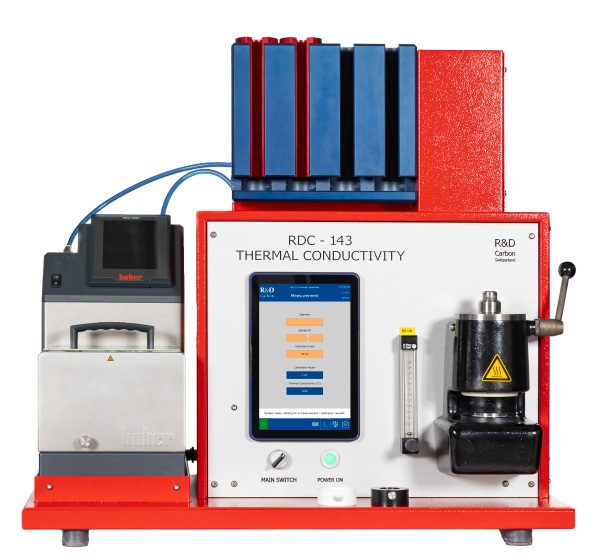
The measurement is conducted with the RDC-143 apparatus, where a sample with a height of 20 mm is clamped between two heads, one heated at 60°C and the other cooled to 20°C. The method is based on a comparative measurement: once the thermal equilibrium is reached, the obtained temperature is measured and compared to the one obtained on a reference material with a known conductivity to determine the electrode thermal conductivity.
Levels from approximately 2 W/mK up to more than 180 W/mK can be measured with this equipment if correct reference materials are used and if the sample’s diameter is adapted (30 mm or 50 mm). The sample preparation must be made with the RDC-140 or the RDC-149 apparatus to ensure adequate parallelism of the sample’s surfaces.
Technical Information

Other Electrodes, Lining Equipment